
How to Fight Spiritual Attacks: 5 Biblical Ways
If you’re wondering how to fight spiritual attacks, these five biblical truths will help you stand firm, resist fear, rely on God’s strength, and move forward in prayer and obedience.
Have you ever had those moments where you felt attacked in every direction, like you were in a battle of sorts, but you weren’t sure what to do?
The arrows flying toward you seem overwhelming, and you begin to wonder if what you’re facing is more than just a normal hard season.
For the past few weeks, my husband and I have been experiencing what has felt like an unusual amount of warfare. We’ve felt surrounded on all sides, and just when we thought one thing had settled, another fiery dart seemed to come flying.
Maybe you’ve been there too.
Maybe you’ve walked through a season where it felt like the pressure was coming from every direction. One thing after another kept happening, and before you knew it, your heart felt heavy, your mind felt tired, and you weren’t even sure how to pray anymore.
When I begin to feel that kind of pressure, one of the first things I’ve learned to do is reach out for prayer.
Not because prayer is my last resort, but because I need people in my life who will help me lift my eyes back to the Lord when the battle feels overwhelming.
As I approached one friend for prayer, she messaged me a Scripture that was exactly what we needed to stand firm. When I shared the verse with my husband, we began to pray and declare those words over our lives.
The verse was 2 Chronicles 20:17:
“You will not have to fight this battle. Take up your positions; stand firm and see the deliverance the LORD will give you, Judah and Jerusalem. Do not be afraid; do not be discouraged. Go out to face them tomorrow, and the LORD will be with you.”
When I went back and read the whole chapter, I realized how much was happening around this one verse.
Jehoshaphat had just received news that a vast army was coming against Judah. The threat was real, and Scripture tells us that he was afraid. But what stood out to me was what he did next.
2 Chronicles 20:3 says that Jehoshaphat “resolved to inquire of the LORD.”
He didn’t pretend the battle wasn’t there. He didn’t deny that he was afraid. But he also didn’t allow fear to become the loudest voice in the room.
He turned toward God.
Jehoshaphat gathered the people together to seek the Lord, and then he began to pray. As I read his prayer, I noticed that he didn’t begin by rehearsing the size of the enemy. He began by remembering who God was.
He remembered God’s power and faithfulness. He remembered what God had done before.
And then, in one of the most honest prayers in the chapter, he said:
“We do not know what to do, but our eyes are on you.”
2 Chronicles 20:12
I love that verse because I think many of us have been there.
We don’t always know what to do when we feel attacked. We don’t always know how to make sense of what is happening around us. Sometimes we can’t tell whether we need to take action, wait, pray, speak, stay quiet, or simply stand.
But Jehoshaphat’s prayer reminds me that I do not have to understand the whole battle before I turn my eyes toward God.
And as I continued reading, I began to see several truths in this chapter and throughout Scripture that have helped me understand how to respond when I feel like I’m under attack.
Here are five biblical truths that have helped me learn how to fight spiritual attacks and stand firm in the middle of the battle.
5 Biblical Ways to Fight Spiritual Attacks
1. Take Your Position
The first thing that stood out to me in 2 Chronicles 20:17 was this phrase:
“Take up your positions…”
I kept thinking about that.
Before the people of Judah were told to stand firm, they were told to take their position.
And I think there is something important in that for us.
When I feel attacked, my natural response is often to focus on the battle in front of me. I start thinking about what I need to fix, what I need to control, what I should say, or how I can make the situation turn out differently.
But before I do any of that, I need to remember my position.
As a believer, my position is in Christ.
That means I do not have to face the enemy trying to prove that I am good enough, strong enough, spiritual enough, or capable enough.
My confidence is not in me, it is in Jesus.
John 1:12 says:
“Yet to all who did receive him, to those who believed in his name, he gave the right to become children of God.”
I love this verse because that word translated “right” carries the idea of authority or a granted right.
Through Christ, I have been given the right to become a child of God.
But to all who believed him and accepted him, he gave the right to become children of God. John 1:12
So when the enemy attacks my identity, I do not have to answer him from my feelings.
I can answer from truth:
I belong to God.
I am His child.
I have been brought near through Christ.
I am not abandoned.
I am not trying to earn a place in God’s family; I am already in His family.
This matters because so many battles become harder when we forget who we are.
When fear tells me I’m alone, I need to remember who my Father is.
When accusation tells me my past defines me, I need to remember what Christ has done.
When insecurity tells me I have to prove myself, I need to remember that my identity is received from God, not earned through performance.
Taking my position in Christ does not mean I ignore the battle.
It means I refuse to let the battle tell me who I am.
2. Stand Firm in God’s Truth
The next thing God told Judah to do was:
“Stand firm…”
That phrase stood out to me because standing firm sounds simple until you are actually in the middle of a battle.
Standing firm can feel difficult when fear is loud, when your circumstances seem to contradict what you have been praying for, or when you are tired, discouraged, and unsure of what God is doing.
So what does it actually mean?
When I think about standing firm in a spiritual battle, I immediately think about Ephesians 6.
Paul tells believers:
“Put on the full armor of God, so that you can take your stand against the devil’s schemes.”
—Ephesians 6:11
Then, a few verses later, he says it again:
“Therefore put on the full armor of God, so that when the day of evil comes, you may be able to stand your ground…”
—Ephesians 6:13
I don’t think it is an accident that Paul keeps coming back to the idea of standing.
But what really caught my attention was how he tells us to stand.
He points us to truth, righteousness, the gospel of peace, faith, salvation, and the Word of God.
In other words, God does not tell us to stand firm by trying to become stronger in ourselves.
He anchors us in what He has given us.
I think sometimes, when we feel spiritually attacked, our first instinct is to focus on the enemy. We start watching every circumstance, analyzing every setback, and wondering what might happen next.
But Ephesians 6 keeps bringing us back to what is true.
And this is exactly what we see Jesus do in Matthew 4.
When Jesus was tempted in the wilderness, Satan repeatedly tried to move Him away from the Father’s will. And each time, Jesus came back to the same foundation:
“It is written…”
I recently spent some time studying that phrase, and it has stayed with me.
Jesus did not allow the enemy to redefine truth. He came back to what God had already said.
And I think this is where many of our battles are fought, too.
When fear tells me that everything depends on me, what has God said?
When shame tells me that I am condemned, what has God said?
When anxiety tells me that I need to control every possible outcome, what has God said?
When discouragement tells me that nothing will ever change, what has God said?
This is why studying Scripture matters so much.
We cannot stand on truth we do not know.
And I don’t say that to make Bible study feel like another thing you have to perform perfectly. I say it because I have seen in my own life how easily fear, emotions, and circumstances can begin shaping what I believe when I am not intentionally coming back to God’s Word.
Sometimes I do not need a new answer; sometimes I need to return to what God has already said.
Standing firm does not mean pretending the battle is not real.
It means refusing to let the battle become more authoritative than the Word of God.
3. Rely on God’s Strength, Not Your Own
This one is especially personal for me because my natural response to pressure is often to start trying harder.
When something feels wrong, I want to fix it. When I don’t understand what is happening, I want to figure it out. And when I feel afraid, I can start thinking through every possible outcome and what I can do to prevent the one I don’t want.
Before I realize it, I am exhausted from trying to carry something God never asked me to carry in my own strength.
I think this is one of the reasons I love the story of David and Goliath so much.
From a human perspective, David looked completely outmatched. Goliath had the size, the armor, the weapons, and the experience.
But David understood something Goliath did not.
The outcome of the battle was not dependent on David being stronger than his opponent.
In 1 Samuel 17:45–47, David made it clear that his confidence was in the Lord. He did not walk toward Goliath confident in his own strength. He walked forward confident in God.
And I have to ask myself sometimes: Where is my confidence really resting?
Is it resting in my ability to solve the problem? To say the right thing? To plan far enough ahead? To control how other people respond?
Or am I actually depending on God?
I think many of us genuinely love God, but when pressure comes, we instinctively move into self-reliance. We pray, but then we carry. We ask God for help, but then spend the rest of the day trying to control the outcome.
I know this because I have done it.
Psalm 46:1 reminds us that God is our refuge and strength, an ever-present help in trouble.
That means I do not have to manufacture the strength I need for the battle. I can receive it from Him.
Sometimes one of the most honest prayers I can pray is:
“Lord, I am trying to carry this in my own strength again. Help me depend on You.”
4. Refuse to Let Fear Lead You
One of the things I appreciate most about the story of Jehoshaphat is that Scripture does not pretend he was fearless.
When he heard that the vast army was coming against Judah, 2 Chronicles 20:3 tells us that he was afraid. I love the honesty of that.
Because sometimes we read verses that tell us not to fear and assume that if we feel afraid, we must be failing. But Jehoshaphat felt fear.
The difference was that he did not let fear determine where he turned.
He turned toward the Lord. I think that distinction matters.
Fear may be present, but it does not have to lead.
We see something similar in David’s story.
Before David ever stood in front of Goliath, he remembered what God had already done.
He remembered the lion. He remembered the bear. He remembered that God had delivered him before.
And I think there is something powerful about that.
When fear gets loud, it has a way of narrowing our vision until all we can see is the battle in front of us.
We forget the prayers God has already answered.
We forget the doors He has already opened.
We forget the seasons He has already carried us through.
We forget that some of the things we once thought would break us became places where we experienced His faithfulness.
I have had to learn to intentionally remember.
Sometimes I stop and ask myself:
- Where has God met me before?
- How has He provided for me?
- What prayers has He already answered?
- What have I survived that I once thought I never could?
- How have I seen His faithfulness in past seasons?
Remembering does not mean I assume God will handle every situation exactly the way I want, nor does it mean I know what the outcome will be.
But it does remind me that the God I am trusting today is the same God who has been faithful to me before.
This is one of the reasons I love the way Jehoshaphat prayed in 2 Chronicles 20.
Before he asked God for help, he remembered who God was and what God had done.
He brought the current battle into the context of God’s character.
And I think I need to do the same.
Because fear will always try to interpret God through the lens of my circumstances.
Faith brings my circumstances back under the truth of who God is.
So when fear begins to rise, I do not have to pretend I feel nothing.
I can acknowledge what I am feeling and still choose where I place my trust.
5. Move Forward in Prayer and Obedience
The final thing that stands out to me in 2 Chronicles 20:17 is that God told Judah:
“Go out to face them tomorrow, and the LORD will be with you.”
They were told that the battle belonged to God, but they were still called to move forward.
I think sometimes we assume trusting God means doing nothing. And sometimes, waiting truly is obedience.
But other times, God calls us to take the next step while continuing to depend on Him.
This is where prayer and obedience come together.
After Paul describes the armor of God in Ephesians 6, he continues with a call to pray in the Spirit on all occasions.
That’s important because prayer is not supposed to be our last resort after we have exhausted every other option.
Prayer is part of how we live, dependent on God in the middle of the battle.
I am learning that prayer is not always about getting immediate instructions for the next ten steps. Sometimes I want God to show me the entire plan because knowing the plan makes me feel safer. But often, He gives enough light for the next faithful step.
That next step could look like forgiving someone, asking for help, setting a healthy boundary, or confessing sin. Other times, it may be opening the Bible instead of continuing to rehearse fearful thoughts or staying quiet when everything in you wants to defend yourself.
Discernment is so important because there is no one-size-fits-all answer for every battle.
But we can pray, search Scripture, and ask the Holy Spirit for counsel.
And then we can obey what God is showing us.
I keep coming back to Jehoshaphat’s prayer in 2 Chronicles 20:12:
“We do not know what to do, but our eyes are on you.”
Maybe that is where you are right now.
You do not know how the situation is going to turn out.
You do not know what God is doing behind the scenes.
You do not know how every piece is going to come together.
But you can keep your eyes on Him.
And sometimes, standing firm in a spiritual battle does not look nearly as dramatic as we imagine. Sometimes it simply looks like continuing to pray, continuing to trust, and continuing to obey God one step at a time.
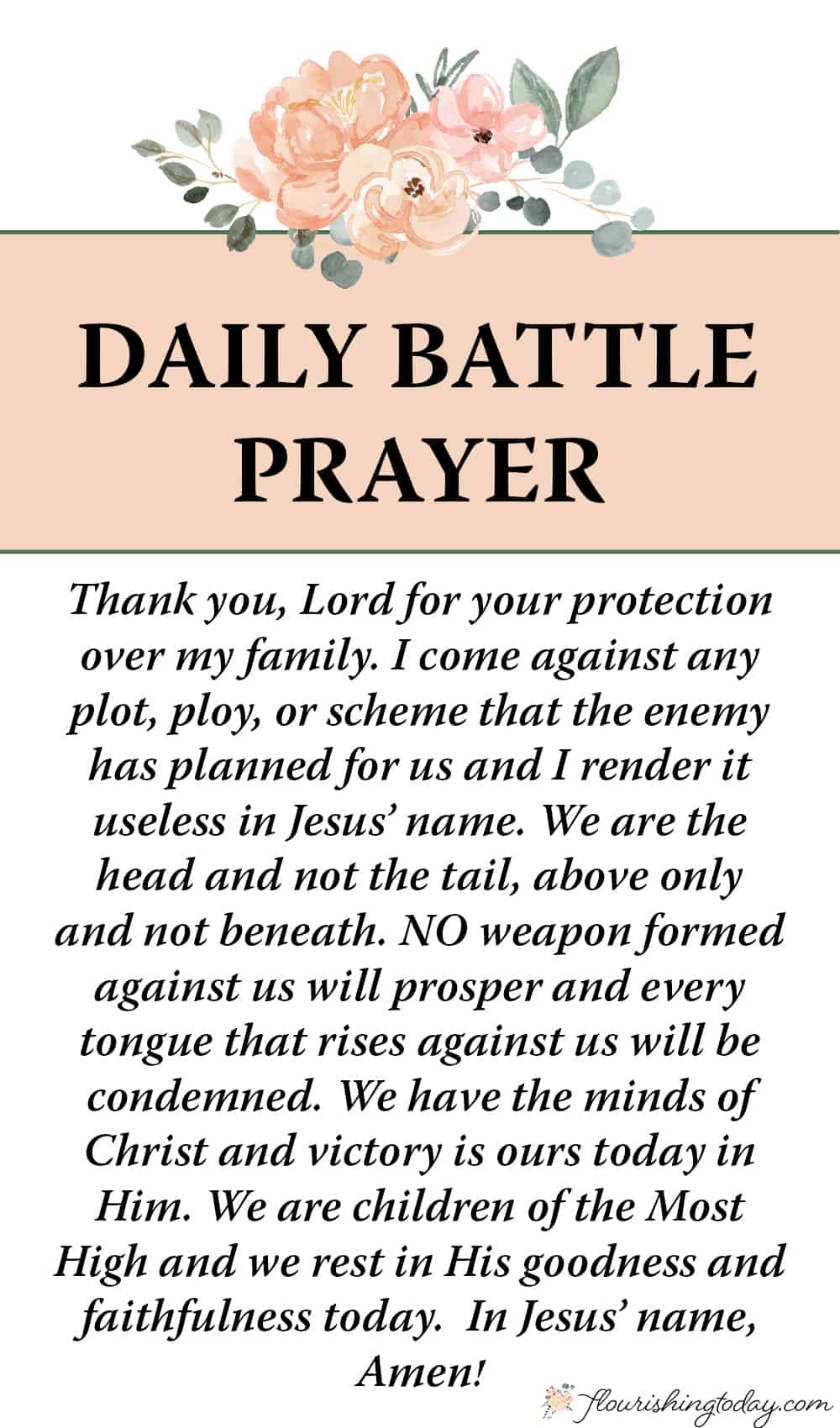
A Prayer for When You Feel Under Attack
Father, I don’t know why everything feels so heavy right now, but I know I don’t have to face this battle alone.
Help me recognize the lies of the enemy and come back to the truth of Your Word.
When fear tries to overwhelm me, remind me that You have not given me a spirit of fear. When my thoughts begin to spiral, help me take them captive and bring them back into agreement with Your truth.
Lord, strengthen me to stand firm.
Guard my heart, protect my mind, and help me resist every temptation to panic, strive, or fight this battle in my own strength.
You are my refuge. You are my Defender. And no matter what I’m facing today, help me remember that greater is He who is in me than he who is in the world.
I choose to trust You. I choose to stand on Your Word. And I choose to believe that You are with me in this battle.
In Jesus’ name, amen.
Frequently Asked Questions About Spiritual Attacks
What is a spiritual attack?
A spiritual attack is opposition that seeks to draw us away from truth, trust, obedience, and dependence on God. Scripture shows Satan working through temptation, deception, accusation, and lies. We see these patterns in passages such as Genesis 3, Matthew 4:1–11, John 8:44, and Revelation 12:10.
At the same time, I think it is important not to assume that every hardship or inconvenience is automatically a spiritual attack. The Bible teaches that spiritual warfare is real, but it also teaches that believers face ordinary trials, the consequences of choices, temptation from our own desires, and the pain of living in a broken world.
How do I know if I am under spiritual attack?
The Bible does not give us a simple checklist that proves a person is under spiritual attack.
However, Scripture does show recurring patterns such as deception, temptation, accusation, lies, and opposition that seeks to draw people away from trusting and obeying God.
This is why discernment matters. Ask God for wisdom, compare what you are believing with Scripture, pay attention to whether fear or accusation is pulling you away from truth, and invite mature believers to pray with you when needed.
What does the Bible say about spiritual warfare?
One of the clearest passages about spiritual warfare is Ephesians 6:10–18. Paul teaches that believers face a real spiritual struggle and calls us to be strong in the Lord, put on the armor of God, stand firm, take up the shield of faith, use the Word of God, and continue in prayer.
Other passages, including Matthew 4:1–11, 1 Peter 5:8–9, James 4:7, and 2 Corinthians 10:3–5, also help us understand temptation, resistance, spiritual opposition, and the importance of bringing our thoughts under the truth of Christ.
What should I pray when I feel spiritually attacked?
When you feel spiritually attacked, you can honestly tell God what you are experiencing and ask Him for wisdom, discernment, protection, strength, and help standing firm in truth.
You can ask Him to expose lies you have believed, help you resist temptation, guard your heart and mind, and show you where fear may be influencing your response.
You can also pray Scripture, using God’s Word to bring your thoughts and fears back into alignment with what is true.
How can I stand firm during spiritual warfare?
Standing firm begins with dependence on God rather than confidence in yourself.
Ephesians 6 points believers toward truth, righteousness, the gospel of peace, faith, salvation, the Word of God, and prayer. Practically, that means knowing what God has said, recognizing lies that contradict His Word, remembering your identity in Christ, relying on His strength, praying, resisting temptation, and continuing in faithful obedience.
Standing firm does not mean you never feel afraid or discouraged. It means those feelings do not become the final authority over what you believe or how you respond.